
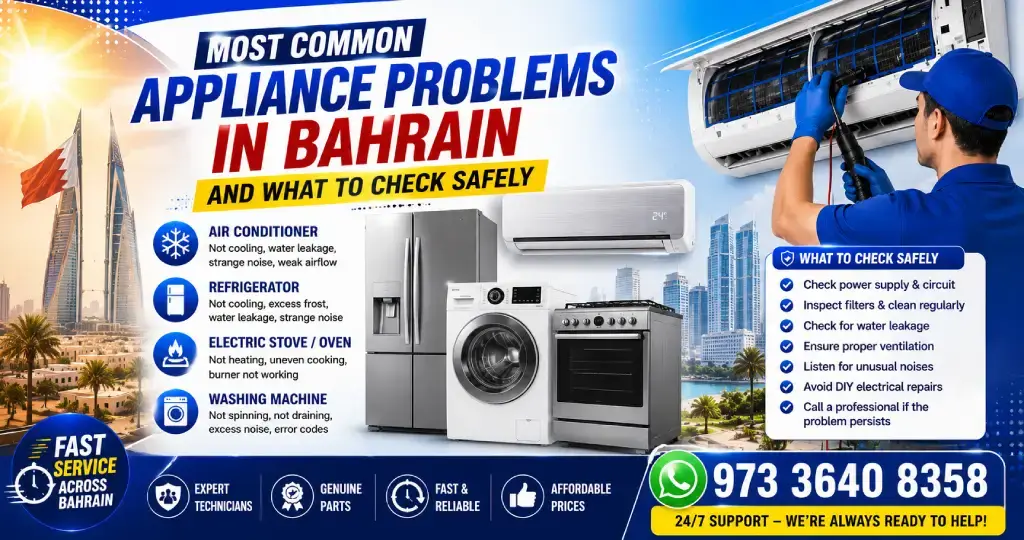
An AC that stops cooling, a fridge that feels warm, or a stove burner that will not heat can disrupt a home or business very quickly.
The most common appliance problems in Bahrain include blocked AC filters, water drainage faults, refrigerant leaks, fridge door-seal problems, freezer ice buildup, failed heating elements, and electrical control faults.
Some causes are simple enough to check safely. Others need diagnostic testing by an appliance repair technician. This guide explains the warning signs, the checks you can perform, and the situations where you should switch the appliance off.
Quick answer: Common appliance faults in Bahrain include AC cooling loss, AC water leaks, noisy HVAC systems, refrigerators not cooling, freezer ice buildup, leaking fridges, stove burners not heating, and ovens with unstable temperatures. Check settings, filters, airflow, seals, ventilation, and the breaker first. Stop using the appliance if you notice smoke, sparking, burning smells, exposed wiring, or water near electrical parts.
The Most Common Appliance Problems in Bahrain at a Glance
| Symptom | Possible cause | Safe first step | Technician needed? |
|---|---|---|---|
| AC runs but does not cool | Dirty filter, blocked coil, refrigerant leak, compressor fault | Check mode, temperature, filter, doors and windows | Yes, if cooling does not improve |
| Water drips from AC | Blocked drain, dirty filter, frozen coil, damaged tray | Turn it off and check for visible blockage | Usually |
| AC makes a new loud noise | Loose cover, fan fault, motor wear, compressor problem | Remove loose objects near the unit | Yes, for grinding or banging |
| Refrigerator feels warm | Door left open, poor seal, blocked vents, fan or compressor fault | Check settings, door seal and ventilation | Yes, if cooling stays weak |
| Water under the fridge | Spill, condensation, blocked drain, water-line leak | Dry the area and find where water returns | Yes, if leakage continues |
| Freezer has heavy ice | Door-seal gap, frequent opening, defrost fault | Check the door closes fully | Yes, if ice quickly returns |
| Stove burner does not heat | Wrong control, unsuitable pan, failed element or switch | Check the selected control and cookware | Yes, if the fault remains |
| Oven cooks unevenly | Wrong mode, poor rack position, sensor or element fault | Confirm the mode and test with another dish | Yes, if temperatures remain unstable |
| Breaker repeatedly trips | Wiring, element, motor or control-board fault | Stop using the appliance | Yes |
| Burning smell or smoke | Overheating or electrical failure | Switch off power if safe | Urgent inspection |
Why Appliances Develop Problems in Bahrain Homes
Appliance failures rarely have one single cause.
An appliance may be affected by dust, moisture, long operating hours, blocked airflow, poor ventilation, worn parts, or an electrical fault. Apartments near busy roads or construction may collect dust faster. Homes near the coast may also deal with humid and salty air.
These conditions do not prove that a major part has failed. They simply make cleaning, ventilation, inspection, and routine servicing more important.
The exact fault still needs to be confirmed through proper testing.
Common Air-Conditioner Problems
Air conditioners often run for long periods in homes, offices, shops, and restaurants. Small airflow or drainage problems can therefore become noticeable very quickly.
1. The AC Is Running but Not Cooling
An AC not cooling in Bahrain may still blow air from the indoor unit. The airflow may feel weak, slightly cool, or close to room temperature.
Common possible causes include:
- A dirty air filter
- Closed or blocked vents
- An incorrect thermostat mode
- A dirty indoor or outdoor coil
- Ice on the evaporator coil
- A refrigerant leak
- A weak fan motor
- A faulty sensor or thermostat
- A capacitor or compressor problem
A blocked filter restricts airflow and reduces cooling performance. Low refrigerant may also cause weak cooling, ice buildup, or a hissing sound. Refrigerant should not normally disappear during operation. Low pressure may point to leakage or an incorrect charge.
What You Can Check Safely
Before booking split AC repair in Bahrain, check:
- Is the unit set to Cool rather than Fan?
- Is the set temperature lower than the room temperature?
- Is the filter visibly covered in dust?
- Are furniture or curtains blocking the unit?
- Are windows and outside doors closed?
- Is there visible ice on the indoor coil or pipe?
- Is the outdoor unit blocked by stored items?
Only clean a filter if it is designed for user removal. Follow the manufacturer’s instructions.
Do not open electrical covers, handle refrigerant pipes, or attempt an AC gas refill yourself.
2. The AC Is Leaking Water Indoors
AC leaking water in Bahrain homes is often linked to drainage or airflow.
Possible causes include:
- A blocked condensate drain
- Dirt inside the drain tray
- A frozen evaporator coil
- A heavily blocked filter
- A damaged drain pipe
- Poor indoor-unit alignment
- A cracked drain tray
- A failing drain pump in some systems
Condensation is normal inside an operating AC. It should flow through the drain system. Water entering the room means that process is not working correctly.
What to Do
Turn off the AC if water is reaching:
- A wall socket
- An extension lead
- Exposed wiring
- A control panel
- A ceiling light
- Other electrical equipment
Place a container under a small drip only if you can do so safely. Do not remove the unit cover or push tools into the drain line.
Water leakage can also appear when a dirty filter contributes to weak airflow and coil icing. Manufacturer guidance confirms that restricted airflow can reduce cooling and contribute to condensation problems.
3. The AC Is Making an Unusual Noise
Every AC makes some sound. The important warning sign is a noise that is new, louder, or different.
Common sounds include:
- Rattling: A loose panel, screw, grille, or nearby object
- Buzzing: An electrical part, motor, contactor, or loose fitting
- Clicking: Normal during starting, but repeated clicking may indicate a control fault
- Whistling: Restricted airflow or a gap around a filter
- Grinding: Worn fan-motor or bearing parts
- Banging: A loose or damaged mechanical component
- Hissing: Air movement or a possible refrigerant leak
A change in AC sound can be an early sign that a component needs inspection. Installation position, fan contact, and compressor operation may all affect noise.
Switch the system off if you hear heavy grinding, repeated banging, or a loud electrical buzz.
4. The AC Has Ice on the Coil or Pipe
Ice does not mean the AC is producing extra cooling.
It may be caused by:
- Restricted airflow
- A dirty filter
- A blocked coil
- A fan problem
- Low refrigerant
- A sensor fault
- Extended operation during an unresolved cooling problem
Turn the unit off and allow the ice to melt naturally. Keep water away from electrical items.
Do not chip the ice with a knife or screwdriver. This can damage the coil or refrigerant pipe.
If ice returns, the system needs airflow, temperature, and refrigerant testing.
5. The AC Trips the Breaker
A single breaker trip can sometimes follow a temporary electrical event. Repeated trips are different.
Possible causes include:
- A failing motor
- A compressor drawing too much current
- A damaged capacitor
- Faulty wiring
- Water reaching an electrical part
- A control-board fault
- A problem with the electrical circuit
Do not keep resetting the breaker. Repeated trips mean that the fault has not been removed.
A technician or qualified electrician may need to determine whether the problem is inside the AC or within the property’s electrical supply.
Split AC and Central AC Faults Are Not Diagnosed the Same Way
A split AC usually serves one room or zone. A central AC or ducted HVAC system may serve several rooms.
With a split unit, weak cooling may come from the indoor unit, outdoor unit, connecting pipework, drain, or controls.
With central AC repair in Bahrain, technicians may also need to inspect:
- Duct airflow
- Zone controls
- Thermostats
- Air-handling units
- Fan-coil units
- Dampers
- Drain pumps
- Shared electrical controls
If several rooms lose cooling at the same time, the problem may be in a shared part of the system.
Soft CTA: If basic filter, thermostat, and airflow checks do not restore cooling, the system may need pressure, electrical, drainage, or airflow testing. Al Anwar’s AC repair service in Bahrain covers split, window, and central cooling faults.
Common Refrigerator and Freezer Problems
A refrigerator problem should not be ignored. Cooling loss can affect stored food before the appliance stops completely.
1. The Refrigerator Is Not Cooling
A refrigerator not cooling may have a simple airflow problem or a more serious sealed-system fault.
Possible causes include:
- Incorrect temperature settings
- A door that is not closing fully
- A dirty or damaged door seal
- Food blocking internal vents
- Poor ventilation around the appliance
- A fan fault
- Heavy frost around the evaporator
- A thermostat or sensor fault
- A start relay problem
- A compressor or refrigerant-system fault
Door seals should sit evenly against the cabinet. Dirt, damage, or gaps can allow warm air to enter and reduce cooling.
Safe Checks
You can safely check:
- The power plug and display
- The temperature setting
- Whether the door closes without resistance
- The rubber seal for dirt, folds, or tears
- Whether food is blocking internal air vents
- Whether the appliance has ventilation space
- Whether the inside light turns off when the door closes
- Whether the freezer has heavy ice buildup
Do not remove rear electrical covers or touch compressor wiring.
2. The Fridge Is Cooling Unevenly
Fridge temperature problems may affect only one shelf, drawer, or section.
Common causes include:
- Overpacking
- Blocked air vents
- Food placed directly against a cold-air outlet
- Frequent door opening
- A poor door seal
- A weak circulation fan
- A faulty temperature sensor
- Ice blocking internal airflow
Leave space around internal vents. Avoid packing food tightly against the back wall.
If one section freezes food while another remains warm, a sensor, damper, fan, or airflow channel may need testing.
3. The Fridge Is Leaking Water
A fridge leaking water may be caused by the appliance, but first rule out a spill.
Dry the area completely and watch where the water returns.
Possible causes include:
- A spilled container
- Condensation
- A blocked defrost drain
- A damaged drain tray
- An overflowing tray
- A loose water-filter connection
- A damaged ice-maker or dispenser line
- A door that was left partly open
Manufacturer troubleshooting advice recommends identifying the exact source first because spills and condensation can look like appliance leaks. Persistent leakage may require service.
Safety Warning
Unplug the refrigerator only if the plug is dry and safely accessible.
Do not touch a wet plug, socket, cable, or extension lead. Switch off the circuit from a safe location and contact an electrician when water is near the electrical supply.
4. The Freezer Has Too Much Ice
A thin layer of frost can occur in some freezer designs. Thick ice that covers panels, drawers, or vents is a problem.
Possible causes include:
- A door left open
- A dirty or damaged seal
- Warm air entering through a gap
- Frequent door opening
- Blocked airflow
- A defrost heater fault
- A defrost sensor fault
- A drain problem
Check that no food package is stopping the door from closing.
Do not use sharp tools, boiling water, or a heat gun to remove ice. These methods may damage the liner, wiring, or refrigerant tubes.
Follow the manufacturer’s defrost instructions.
5. The Refrigerator Makes Loud or Repeated Noises
Refrigerators normally make humming, airflow, dripping, and occasional clicking sounds.
A technician should inspect noises such as:
- Loud grinding
- Repeated start-and-stop clicking
- Metal knocking
- A fan striking ice
- A compressor that hums but does not start
- Noise followed by loss of cooling
A refrigerator compressor issue cannot be confirmed by sound alone. The start relay, fan, mounting parts, refrigerant system, or compressor may produce similar symptoms.
Diagnostic testing may include voltage, current, temperature, fan, relay, and pressure checks.
6. The Refrigerator Runs Almost Constantly
Long running times may be caused by:
- Frequent door opening
- Warm food being added
- Poor ventilation
- A dirty door seal
- High room temperature
- Blocked internal airflow
- A fan or sensor problem
- Weak cooling performance
This does not always mean compressor failure.
Check the seal, settings, food placement, and ventilation first. Arrange refrigerator repair in Bahrain if cooling remains poor or the compressor repeatedly struggles to start.
For a deeper fridge-only guide, see the most common fridge problems in Bahrain.
Common Electric Stove and Oven Problems
Electric stoves combine high heat with high electrical load. Repairs inside the appliance should be left to a trained technician.
1. An Electric Stove Burner Is Not Heating
An electric stove not heating may have one failed burner while the other zones still work.
Possible causes include:
- The wrong control was selected
- A control lock is active
- Unsuitable cookware on an induction hob
- The cookware is not sitting flat
- A failed heating element
- A damaged burner socket
- A faulty temperature limiter
- A failed control switch
- A wiring or control-board fault
For an induction cooktop, confirm that the pan is induction-compatible and centred over the cooking zone.
For a sensor-controlled coil, a dirty surface or uneven cookware may affect operation.
Do not remove a burner, glass panel, switch, or control board unless the manufacturer specifically identifies it as a user-removable part.
2. All Stove Burners Stop Working
If all burners fail at the same time, possible causes include:
- Loss of electrical supply
- A tripped breaker
- A control lock
- A failed main control
- Incorrect electrical connection
- Internal wiring damage
Check the display and breaker once.
If the breaker trips again, leave it off. Manufacturer guidance recommends professional service when several surface burners fail while other stove functions still work.
3. The Oven Is Not Heating Properly
An oven temperature issue may cause slow heating, uneven cooking, or food burning on one side.
Possible causes include:
- The wrong cooking mode
- Incorrect rack placement
- A damaged door seal
- A failed bake or grill element
- A weak fan
- A faulty thermostat or sensor
- A control-board fault
- Electrical supply problems
A visible break, crack, or blister on an exposed element may indicate damage. Do not touch or remove it.
Turn off the cooker at the breaker before any visual check inside a cool oven. GE’s support guidance similarly advises disconnecting power before inspecting an electric oven element.
4. The Burner Cycles On and Off
A burner that turns on and off is not always faulty.
Many electric cooktops cycle power to hold the selected temperature and prevent overheating.
A fault is more likely when:
- The zone never becomes hot
- It stays fully hot at a low setting
- It switches off too quickly
- The control does not respond
- The breaker trips
- A burning smell appears
5. The Stove or Oven Has a Burning Smell
A new appliance may produce a temporary manufacturing smell during its first uses. Follow the manufacturer’s first-use instructions and ventilate the kitchen.
Stop using an older appliance when the smell is:
- Sharp or electrical
- Coming from the controls
- Coming from the plug or socket
- Accompanied by smoke
- Accompanied by sparking
- Accompanied by a hot cable
- Followed by a breaker trip
Switch the appliance off. Disconnect it only if the plug is cool, dry, and safely accessible.
Electrical-safety guidance recommends immediately stopping use when an appliance produces sparking, burning smells, unusual sounds, hot plugs, or repeated breaker trips.
6. The Stove Keeps Tripping the Breaker
A stove burner not working together with breaker trips may indicate:
- A shorted heating element
- Damaged wiring
- Moisture inside the appliance
- A faulty control switch
- A damaged terminal
- Incorrect electrical installation
- A control-board failure
Do not repeatedly reset the breaker.
An appliance repair technician may need to test the stove. A qualified electrician may also need to check the circuit, isolator, socket, or electrical connection.
Safe Appliance Troubleshooting You Can Do
Basic appliance troubleshooting should stay outside sealed, high-voltage, gas, and refrigerant systems.
Safe checks usually include:
- Reading the appliance display or error code
- Checking the operating mode
- Checking the temperature setting
- Checking the breaker once
- Cleaning a user-accessible AC filter
- Opening blocked air vents
- Moving items away from ventilation spaces
- Checking a fridge door seal
- Removing food blocking internal fridge vents
- Confirming that stove cookware is suitable
- Looking for visible water, ice, smoke, or damaged cables
- Checking the user manual
Before cleaning, switch the appliance off and follow its manual.
Repairs You Should Not Attempt
Do not attempt to:
- Refill AC refrigerant
- Release refrigerant
- Repair an AC or refrigerator compressor
- Open a sealed cooling system
- Touch exposed wiring
- Test live electrical parts
- Bypass a safety switch
- Open a capacitor
- Repair a control board
- Remove high-voltage stove parts
- Repair gas pipes or valves
- Work on a wet electrical appliance
- Keep resetting a tripping breaker
These tasks require training, correct instruments, and appliance-specific procedures.
When the Appliance Should Be Switched Off
Stop using the appliance when you notice:
- Smoke
- Sparking
- A strong burning smell
- A hot or melted plug
- Exposed wiring
- Water near electricity
- Repeated breaker trips
- Loud grinding or metal impact
- A cracked electric hob
- A gas smell from any cooking appliance
- Severe vibration
- Loss of cooling with repeated compressor clicking
Electrical items exposed to significant water can create shock and fire risks. They should not be powered again until inspected.
Repair or Replace: How to Make the Decision
The most expensive-looking symptom does not always require replacement. A small sensor or airflow problem can sometimes resemble a major failure.
Consider repair when:
- The appliance has generally worked well
- The fault affects one replaceable part
- The cabinet and structure are in good condition
- There is no serious heat or water damage
- Replacement parts are reasonably available
- The quoted repair cost makes sense for the appliance
Consider replacement when:
- The appliance has several unrelated faults
- Repairs have become frequent
- The cabinet, wiring, insulation, or cooking surface is badly damaged
- A major part has failed and the full repair cost is high
- The appliance no longer meets the household’s needs
- The manufacturer no longer supports important parts
- Safe operation cannot be restored
Ask for a written diagnosis and quote before deciding. Repair costs depend on the model, fault, access, labour, and required spare parts.
How to Reduce Repeat Appliance Problems
Preventive maintenance cannot stop every failure, but it can reduce avoidable strain.
For Air Conditioners
- Clean user-accessible filters as instructed
- Keep vents open
- Keep the outdoor unit clear
- Investigate water leakage early
- Arrange servicing when cooling becomes weak
- Do not ignore ice or unusual noise
For Refrigerators
- Keep internal vents clear
- Clean door seals gently
- Allow space for ventilation
- Avoid leaving doors open
- Do not overload shelves
- Investigate water leaks and heavy frost
For Electric Stoves and Ovens
- Keep cooking zones clean and dry
- Use suitable flat cookware
- Do not cover ventilation openings
- Clean spills after the appliance cools
- Stop using cracked glass surfaces
- Investigate breaker trips immediately
Always follow the maintenance schedule in the appliance manual.
When to Call an Appliance Repair Technician
Book professional appliance repair in Bahrain when:
- Safe checks do not solve the problem
- Cooling continues to weaken
- Water leakage returns
- Ice repeatedly forms
- A motor or compressor struggles to start
- The appliance overheats
- An error code returns
- A burner or oven element does not heat
- Temperatures remain unstable
- The breaker trips again
- You smell burning
- The repair requires opening a sealed or electrical section
A proper inspection may involve checking airflow, temperature, drainage, resistance, voltage, current, sensors, fans, controls, and mechanical parts.
The exact repair should be based on test results rather than the symptom alone.
Conclusion
The most common appliance problems in Bahrain often begin with simple warning signs: weak airflow, unstable temperatures, water leakage, unusual sounds, ice buildup, or a burner that stops heating.
Start with safe checks such as settings, filters, vents, seals, ventilation, cookware, and the breaker. Do not open sealed cooling systems or electrical panels.
If the problem returns, affects safety, or involves refrigerant, wiring, motors, heating elements, or compressors, arrange professional testing. Early diagnosis may help prevent water damage, food loss, electrical risk, and damage to other components.
Need Appliance Repair in Bahrain?
Al Anwar AC Repair provides AC, refrigerator, freezer, electric stove, and oven repair services in Bahrain.
Call +973 3513 2160 or WhatsApp +973 3640 8358 and describe the appliance, model, warning signs, and your location. The contact details and Hamala business location are listed on the company website.
Frequently Asked Questions
What are the most common appliance problems in Bahrain?
Common problems include AC cooling loss, AC water leakage, blocked drainage, noisy fans, fridge cooling problems, freezer ice buildup, leaking refrigerators, failed stove burners, and inaccurate oven temperatures. Dust, restricted airflow, worn parts, poor ventilation, moisture, and electrical faults may contribute. The unit still needs testing to confirm the exact cause.
What should I check before calling an appliance technician?
Check the operating mode, temperature setting, breaker, airflow, vents, door seals, ventilation space, and any visible water or ice. For a stove, confirm that the correct control and suitable cookware are being used. Do not remove panels, touch wiring, or open a refrigerant system.
Does an AC that is not cooling always need gas?
No. An AC may stop cooling because of a dirty filter, blocked airflow, a dirty coil, incorrect settings, a fan fault, ice buildup, or an electrical problem. Low refrigerant is only one possible cause. If refrigerant is low, the system should also be checked for leakage.
Why is my refrigerator running but not getting cold?
The door may not be sealing, internal vents may be blocked, the temperature setting may be wrong, or a fan may have stopped. Heavy frost can also block airflow. More serious causes include a sensor, relay, compressor, or refrigerant-system fault. Check the seal and vents before arranging an inspection.
Is freezer ice buildup normal?
A small amount of frost may be normal in some models. Thick ice covering vents, panels, or drawers is not. Check that the door closes fully and the seal is clean. If ice returns after correct defrosting, the appliance may have a defrost, drainage, airflow, or door-seal problem.
Why does my electric stove burner turn on and off?
Many electric burners cycle on and off to maintain the selected heat level. This can be normal. Arrange testing if the burner stays cold, overheats, ignores the control setting, produces a burning smell, or trips the breaker.
When is an appliance problem an emergency?
Stop using the appliance when there is smoke, sparking, exposed wiring, a strong burning smell, repeated breaker trips, severe water leakage near electricity, a gas smell, or loud mechanical grinding. Switch off the power from a safe location and contact a trained technician or electrician.
Research Source Note
Technical guidance was checked against current manufacturer support information from Daikin Middle East, LG, Samsung, GE Appliances, and Whirlpool, along with electrical-safety guidance from Electrical Safety First and ESFI. Business contact details and existing-content findings were checked against the Al Anwar AC Repair website.