
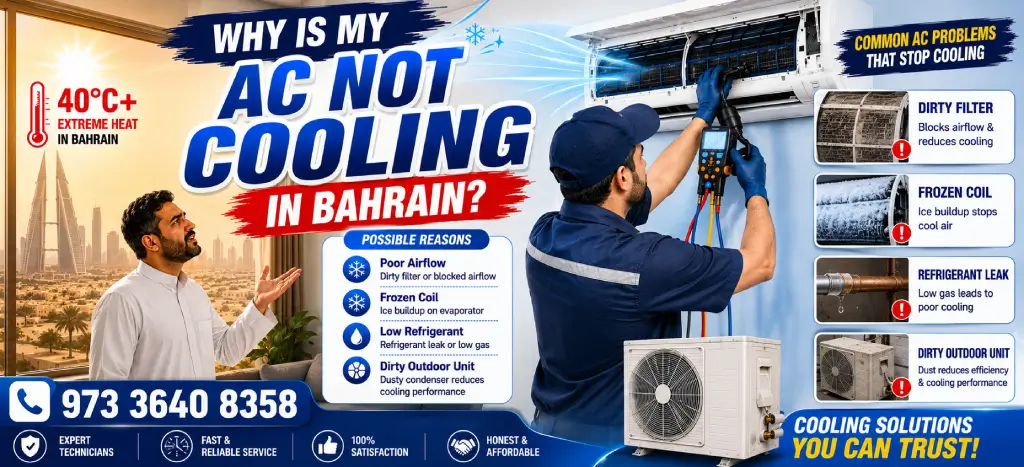
There’s a particular kind of frustration that comes with walking into your home after spending time outdoors in Bahrain’s summer heat, only to find that your air conditioner is running but the room still feels warm and uncomfortable.
The display looks normal. The indoor unit is operating. Air is coming out of the vents.
Yet something clearly isn’t right.
This is one of the most common complaints AC technicians hear every summer across Bahrain. Whether it’s a villa in Riffa, an apartment in Manama, a retail shop in Muharraq, or an office in Isa Town, cooling problems tend to appear when air conditioning systems are under the greatest stress.
What catches many people off guard is that these issues rarely happen overnight. Most cooling failures start quietly. The AC takes a little longer to cool. Rooms feel slightly warmer during the afternoon. Electricity bills begin creeping upward. Then, when temperatures soar above 40°C, the system can no longer keep up.
Many property owners immediately assume the entire unit needs replacement.
In reality, that’s often far from the truth.
After years of servicing air conditioning systems throughout Bahrain, technicians frequently discover that poor cooling performance is usually linked to maintenance neglect, airflow restrictions, refrigerant leaks, dirty components, or environmental conditions that have gradually reduced efficiency.
Understanding what causes these cooling problems can help you avoid unnecessary expenses, identify warning signs early, and keep your system operating reliably throughout Bahrain’s demanding summer season.
Why Air Conditioners Struggle More in Bahrain
Air conditioning systems in Bahrain operate under conditions that are far more challenging than those found in many other parts of the world.
Extreme heat is only part of the equation.
For several months each year, outdoor temperatures regularly exceed 40°C. Add high humidity levels from the Arabian Gulf, airborne dust, construction debris, and coastal salt exposure, and you have an environment that constantly pushes cooling equipment to its limits.
Unlike cooler regions where air conditioners may only run seasonally, many Bahrain properties depend on cooling for most of the year. Compressors, fans, electrical components, and refrigerant systems often operate for extended periods with very little downtime.
That constant workload accelerates wear.
It’s not unusual for an AC system that appeared perfectly healthy during winter to reveal hidden weaknesses once summer arrives and cooling demand increases dramatically.
1. Dirty Air Filters Restrict Airflow and Reduce Cooling
If there is one issue technicians encounter more than almost any other, it’s clogged air filters.
Many homeowners underestimate how important this simple component is.
The filter’s job is to capture dust, dirt, and airborne particles before they enter the system. In Bahrain, filters can become heavily contaminated much faster than people expect, especially in homes near construction projects, open land, busy roads, or coastal areas.
As dust accumulates, airflow becomes restricted.
The system continues running, but it can no longer move enough conditioned air through the property. The AC may technically be producing cool air, yet comfort levels continue to decline because that cooled air isn’t circulating properly.
Typical symptoms include:
- Weak airflow from vents
- Longer cooling times
- Rooms that never reach the thermostat setting
- Increased electricity consumption
- Excess dust around supply grilles
Technicians often describe filter-related service calls as the easiest victories. In some cases, cleaning a severely blocked filter restores cooling performance almost immediately.
For Bahrain properties, monthly filter inspections during peak summer are highly recommended.
2. Refrigerant Leaks and Low AC Gas Levels
If your air conditioner seems to run continuously without effectively lowering indoor temperatures, refrigerant loss could be responsible.
Refrigerant—often called AC gas—is the substance that absorbs heat from inside your property and releases it outdoors. Without the proper refrigerant charge, the cooling cycle cannot function efficiently.
One misconception technicians hear regularly is that refrigerant naturally gets consumed over time.
It doesn’t.
An air conditioning system is a sealed circuit. Under normal conditions, refrigerant levels should remain stable for many years. If the charge is low, there is almost always a leak somewhere in the system.
Common warning signs include:
- Warm or mildly cool air from vents
- Ice forming on refrigerant pipes
- Hissing sounds around copper lines
- Longer cooling cycles
- Gradual decline in cooling performance
A common real-world scenario involves homeowners assuming their AC is struggling because of extreme summer temperatures. After inspection, technicians often discover a small leak in the refrigerant piping that has slowly reduced system efficiency over several months.
Simply adding refrigerant without repairing the leak may temporarily restore cooling, but the issue will return.
The leak itself must be located and corrected.
3. Dirty Condenser Coils Make Heat Removal Difficult
Many people assume an air conditioner creates cold air.
In reality, it removes heat from inside the building and transfers that heat outdoors.
The outdoor condenser coil plays a crucial role in this process.
In Bahrain, condenser coils are constantly exposed to dust, humidity, airborne contaminants, and, in coastal locations, salt deposits. Over time, these materials form a layer across the coil surface.
That layer acts like insulation.
Instead of releasing heat efficiently, the system becomes trapped in a cycle where heat removal slows down and cooling capacity drops.
Property owners commonly notice:
- Rising electricity bills
- Reduced cooling performance
- Longer operating cycles
- Excessive heat around the outdoor unit
- Difficulty maintaining desired temperatures
Technicians frequently find condenser coils so heavily contaminated that the system appears mechanically faulty when the actual issue is simply restricted heat transfer.
Professional coil cleaning is one of the most effective preventive maintenance services available, particularly for Bahrain properties exposed to coastal air or nearby construction activity.
4. Thermostat Issues Can Create Misleading Symptoms
Not every cooling problem originates inside the air conditioner itself.
Sometimes the thermostat is the source of the issue.
The thermostat acts as the system’s control center, constantly measuring room temperature and instructing the AC when to start or stop cooling.
If the thermostat provides inaccurate readings, the entire system can behave unpredictably.
Before assuming a major fault exists, verify the basics:
- Cooling mode is selected
- Temperature is set below room temperature
- Batteries are functioning properly
- Settings haven’t been changed accidentally
- The thermostat isn’t exposed to direct sunlight
Technicians occasionally encounter thermostats installed near windows or in areas receiving afternoon sun. The device senses temperatures that don’t accurately reflect conditions throughout the room, leading to inconsistent cooling and unnecessary service calls.
Sometimes the solution is surprisingly simple.
5. Frozen Evaporator Coils
It may sound contradictory, but excessive ice inside an air conditioner often causes poor cooling.
The evaporator coil absorbs heat from indoor air. When airflow becomes restricted or refrigerant levels fall too low, the coil temperature can drop below freezing.
Moisture in the air then freezes onto the coil surface.
As the ice builds, the system loses its ability to absorb heat effectively.
Common symptoms include:
- Ice visible on indoor components
- Weak airflow
- Water leakage after thawing
- Continuous operation with little cooling effect
Many homeowners notice water dripping from the indoor unit and assume the drain line is blocked. While drain issues certainly occur, technicians frequently discover that melting ice from a frozen evaporator coil is the actual source of the water.
Allowing the system to thaw may provide temporary relief, but the underlying cause still requires diagnosis.
6. Electrical Component Failures
Modern air conditioning systems depend on a complex network of electrical components working together correctly.
Capacitors, contactors, relays, sensors, control boards, and wiring all play important roles in maintaining proper operation.
Bahrain’s extreme heat can accelerate wear on electrical components. Combined with continuous usage and occasional voltage fluctuations, electrical failures become increasingly likely as systems age.
Potential warning signs include:
- Random shutdowns
- Frequent breaker trips
- Buzzing sounds
- Outdoor units failing to start
- Short cycling
One important observation technicians often make is that electrical problems rarely begin as complete failures. Small symptoms frequently appear weeks or months beforehand.
Addressing them early can prevent much larger repairs later.
Because electrical systems involve safety risks, troubleshooting should be handled by qualified professionals.
7. Compressor Problems
The compressor is often referred to as the heart of an air conditioning system.
Without it, refrigerant cannot circulate and cooling simply cannot happen.
Compressor failures usually develop gradually rather than appearing suddenly. Long-term stress caused by dirty coils, restricted airflow, refrigerant issues, or neglected maintenance often contributes to premature wear.
Property owners may notice:
- Warm air despite normal operation
- Loud mechanical noises
- Reduced cooling capacity
- Tripped breakers
- Difficulty maintaining indoor temperatures
Since compressor repairs and replacements are among the most expensive AC services, early diagnosis is extremely important.
A compressor that receives proper maintenance typically lasts significantly longer than one forced to operate under constant strain.
8. Airflow Problems Inside the Property
Not every cooling complaint points to a fault within the AC equipment itself.
Sometimes the system is producing cold air exactly as it should, but that air never reaches occupied areas efficiently.
Technicians frequently discover issues such as:
- Closed vents
- Damaged ductwork
- Obstructed return-air pathways
- Crushed flexible ducts
- Furniture blocking airflow
In residential properties, it’s surprisingly common for large wardrobes, sofas, curtains, or decorative installations to interfere with circulation.
A room can feel noticeably warmer simply because conditioned air cannot move freely throughout the space.
Before assuming major repairs are needed, inspect every vent and airflow pathway within the property.
9. Incorrect AC Sizing
Many property owners believe larger air conditioning systems automatically provide better comfort.
In practice, that’s not always true.
An oversized AC cools the room quickly but may shut off before removing enough humidity from the air. Occupants often describe the environment as cool yet sticky or uncomfortable.
An undersized unit faces the opposite challenge.
It runs continuously while struggling to keep pace with Bahrain’s intense summer heat.
Both situations commonly result in:
- Higher electricity costs
- Uneven temperatures
- Reduced comfort
- Increased wear on components
Proper sizing requires evaluating room dimensions, insulation levels, sunlight exposure, ceiling height, occupancy, and local climate conditions.
Unfortunately, shortcuts during installation sometimes lead to systems that were never appropriately matched to the building.
10. Neglected Maintenance
Many major AC failures start as minor maintenance issues.
A dirty filter may not seem urgent.
A loose electrical connection might appear insignificant.
A thin layer of dust on a condenser coil can easily be ignored.
Months later, those seemingly small issues can contribute to frozen coils, compressor damage, electrical faults, refrigerant problems, and serious efficiency losses.
Routine maintenance delivers several important benefits:
- Better cooling performance
- Lower operating costs
- Improved indoor air quality
- Extended equipment lifespan
- Reduced risk of emergency breakdowns
Technicians consistently observe that systems receiving regular maintenance experience fewer cooling failures during Bahrain’s hottest months.
That’s rarely a coincidence.
How Bahrain’s Climate Accelerates AC Wear
Local environmental conditions have a direct impact on air conditioning reliability.
Heat alone places enormous stress on cooling systems.
Then come the additional challenges:
- High humidity
- Dust storms
- Coastal salt exposure
- Continuous summer operation
- Construction-related airborne debris
These conditions accelerate corrosion, clog filters more quickly, reduce heat-transfer efficiency, and increase overall system workload.
Maintenance schedules recommended for cooler countries often prove insufficient in Bahrain.
Equipment here simply works harder.
Basic AC Troubleshooting Before Calling a Technician
Before arranging professional service, a few quick checks may help identify obvious issues.
Inspect the Thermostat
Confirm cooling mode is selected and the target temperature is lower than the current room temperature.
Check the Air Filter
Remove the filter and inspect it for visible dust buildup. Cleaning or replacing it may improve airflow immediately.
Verify Electrical Power
Ensure breakers haven’t tripped and that both indoor and outdoor units are receiving power.
Examine Air Vents
Make sure vents remain fully open and free from obstructions.
Inspect the Outdoor Unit
Remove dust, debris, leaves, or other materials that may restrict airflow around the condenser.
If cooling performance remains poor after these checks, a professional inspection is usually the most efficient next step.
When Should You Call an AC Repair Professional?
Some issues require specialized tools, testing equipment, and technical expertise.
Professional assistance is recommended when you notice:
- Refrigerant leaks
- Frozen evaporator coils
- Burning odors
- Persistent cooling loss
- Electrical faults
- Compressor-related symptoms
Attempting complex repairs without proper training often creates additional damage and increases repair costs.
Professional diagnosis is usually faster, safer, and more cost-effective in the long run.
Questions Technicians Often Ask During Diagnosis
Experienced technicians can learn a great deal before opening a toolbox.
A few simple questions frequently reveal valuable clues:
- When was the last professional service completed?
- Has the electricity bill increased recently?
- Are some rooms cooler than others?
- Have any unusual sounds appeared?
- Is the system running longer than it used to?
The answers often help narrow down the source of the problem and speed up the diagnostic process.
How to Prevent Future Cooling Problems
Avoiding AC breakdowns is almost always less expensive than repairing them.
Property owners who adopt a consistent maintenance routine typically enjoy better reliability, lower energy costs, and fewer emergency service calls.
A practical maintenance plan includes:
- Cleaning filters monthly
- Scheduling professional servicing twice per year
- Keeping outdoor units clean and unobstructed
- Investigating unusual noises promptly
- Monitoring electricity consumption for sudden changes
- Addressing minor issues before they become major repairs
These habits may seem simple, but they can significantly extend equipment lifespan and improve year-round performance.
Conclusion
If your AC is not cooling in Bahrain, the cause may be as straightforward as a clogged air filter or as complex as a refrigerant leak, electrical fault, airflow restriction, or compressor problem.
What experienced technicians see time and again is that air conditioning systems usually provide warning signs before complete failure occurs. Longer cooling cycles, rising electricity bills, reduced airflow, inconsistent room temperatures, and unusual noises often appear well before a major breakdown.
Bahrain’s climate leaves very little margin for neglect. Constant heat, humidity, dust, and extended operating hours place exceptional demands on cooling equipment throughout the year.
That’s why routine maintenance is not simply a recommendation—it’s one of the most effective ways to protect comfort, control energy costs, and avoid expensive repairs.
If your air conditioner is running constantly, struggling to maintain temperature, or showing signs of declining performance, arranging a professional inspection sooner rather than later can often prevent a minor issue from turning into a costly emergency.