
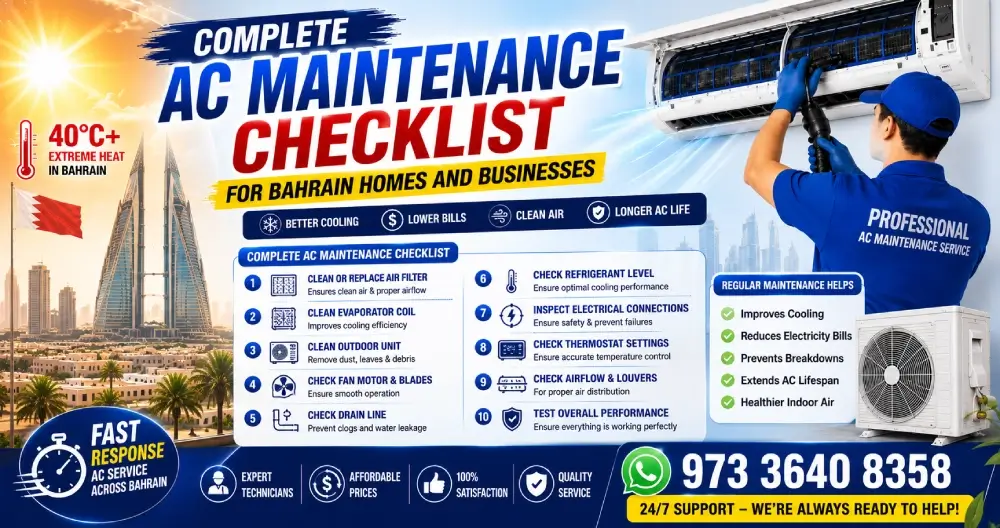
Air conditioners in Bahrain often operate for long periods, allowing dust, moisture, and small mechanical issues to build up quickly. A practical AC maintenance checklist helps you protect airflow, notice water leaks, manage unusual sounds, and arrange professional servicing before a minor fault affects cooling.
Some maintenance steps are safe for homeowners, including checking the thermostat, cleaning a removable filter, keeping vents open, and looking for visible water or ice. Coil washing, refrigerant testing, electrical inspection, and compressor work require suitable equipment, technical knowledge, and safe working procedures.
This guide provides a home AC maintenance checklist for split and central systems. It explains what to check monthly, what a technician should inspect, which warning signs need attention, and how homes, offices, hotels, restaurants, and commercial buildings can plan preventive AC servicing.
Quick answer: An AC maintenance checklist should cover the filter, thermostat, airflow, indoor unit, outdoor condenser, condensate drain, visible pipe insulation, sounds, smells, water leakage, and cooling performance. A technician should handle internal coils, electrical parts, refrigerant pressure, motors, capacitors, contactors, compressors, and sealed-system repairs.
AC Maintenance Checklist at a Glance
| Maintenance item | Safe homeowner check | Professional service task |
|---|---|---|
| Thermostat | Check mode and temperature | Test sensor accuracy and controls |
| Air filter | Clean or replace as instructed | Check airflow after cleaning |
| Indoor vents | Remove visible blockage | Measure airflow and inspect ducts |
| Evaporator coil | Look for visible ice | Clean coil and test its condition |
| Condenser unit | Clear loose objects nearby | Clean coils and inspect fan parts |
| Condensate drain | Look for water or overflow | Clear blockage and test drainage |
| Refrigerant | Watch for weak cooling or ice | Leak testing and pressure checks |
| Electrical system | Note trips or burning smells | Inspect capacitor, contactor, and wiring |
| Blower motor | Listen for unusual sounds | Test motor operation and current |
| Compressor | Note starting problems | Perform electrical and mechanical tests |
Why an AC Maintenance Checklist Matters in Bahrain
Dust can settle on filters, coils, fan blades, and vents, limiting the amount of air passing through the cooling system. Humidity also increases the amount of condensation created inside an operating unit, making clear drainage important for homes and businesses across Bahrain.
An air conditioner transfers heat through an indoor evaporator coil and an outdoor condenser coil. Dirt on either surface can limit heat exchange, while poor airflow may place extra strain on the blower and compressor. Filters, coils, and drains therefore need regular attention.
Preventive maintenance does not guarantee that an AC will never fail. It does, however, help users notice changes in cooling, sound, drainage, airflow, and operating behaviour. Early inspection gives a technician better information and may prevent one fault from affecting nearby components.
Monthly Home AC Maintenance Checklist
The safest monthly checks focus on parts designed for normal user access. Always read the manufacturer’s manual before removing a filter or cleaning a surface. Switch the unit off first, and avoid any panel that exposes wiring, circuit boards, motors, capacitors, or refrigerant pipes.
1. Check the Thermostat Mode
Confirm that the thermostat or remote control is set to cooling mode rather than fan, dry, or heating mode. Check that the selected temperature is below the current room temperature, and make sure timers, sleep settings, or automated schedules are not changing operation unexpectedly.
A thermostat problem may appear as delayed cooling, short operating cycles, incorrect room temperatures, or a unit that ignores commands. Replace remote batteries when needed, but do not open the thermostat, indoor controller, or PCB. Internal sensor and communication faults require proper diagnostic testing.
2. Inspect and Clean the AC Filter
A dirty filter may reduce airflow and allow dust to reach the evaporator coil and blower wheel. Remove the filter only when the manual allows user access. Check for thick dust, damage, loose edges, or material that has become too worn for further cleaning.
Wash a reusable filter using the method approved by its manufacturer, then allow it to dry fully before refitting. Replace disposable filters instead of washing them. Hitachi’s maintenance guidance includes regular filter cleaning while reserving internal coil and motor work for more controlled servicing.
Filter frequency depends on the system, building use, dust level, pets, renovation work, and manufacturer recommendations. Inspecting the filter regularly is safer than following one fixed schedule for every property. Homes near construction or busy roads may notice visible dust sooner.
3. Check Airflow From the Indoor Unit
Stand at a safe distance and compare airflow across the length of the indoor outlet. Weak air, uneven movement, or one side producing less air may indicate a blocked filter, dirty blower, frozen evaporator coil, fan issue, closed vent, or internal airflow restriction.
For central systems, check whether each room receives air through its normal supply vent. Keep furniture, curtains, boxes, and decorative items away from vents. Do not insert tools inside grilles or attempt duct cleaning without suitable access, equipment, and containment procedures.
4. Look for Ice on the Coil or Pipe
Visible ice on an indoor coil, copper pipe, or refrigerant connection is a warning sign rather than proof of strong cooling. Possible causes include restricted airflow, a blocked filter, a dirty coil, fan trouble, a temperature-sensor fault, or low refrigerant caused by leakage.
Switch the AC off and allow the ice to melt naturally. Keep melting water away from sockets, switches, and electrical equipment. Never chip ice with a knife or screwdriver because a sharp object can damage the coil, insulation, wiring, or refrigerant pipe.
5. Check for Water Leakage
Look below the indoor unit, around the drain outlet, near the ceiling, and along any visible drain pipe. Water may come from a blocked condensate drain, dirty drain pan, frozen coil, damaged pipe, failed drain pump, or poor installation alignment.
A condensate drain carries moisture removed from indoor air away from the cooling unit. Drainage inspection is a recognised part of AC maintenance because blockage can cause overflow and property damage. Central systems may use PVC, copper, or pumped drainage arrangements.
Turn the AC off when water approaches a socket, light fitting, extension lead, control panel, or exposed cable. Do not push wire, chemicals, or pressurised air into the drain. A technician should locate the blockage and confirm that water flows correctly afterward.
6. Listen for New or Unusual Sounds
Listen during starting, steady operation, and shutdown. A light airflow sound or occasional control click may be normal, while new rattling, grinding, squealing, buzzing, repeated clicking, or metal impact can indicate loose parts, fan contact, motor wear, electrical trouble, or compressor stress.
Remove only loose objects located outside the unit, such as items touching the casing or blocking the outdoor fan area. Do not open panels to tighten screws or inspect rotating parts. Switch the AC off when sounds become loud, mechanical, repeated, or accompanied by weak cooling.
7. Notice Unusual Smells
A musty smell may be connected to moisture, dust, a dirty filter, a blocked drain, or contamination around the evaporator and drain pan. A burning smell may indicate overheating, damaged insulation, a motor problem, loose electrical connections, or another electrical fault.
Clean only the user-accessible filter and exterior surfaces with approved methods. Do not spray perfume, disinfectant, bleach, or household chemicals into the indoor unit. Switch the system off immediately if the smell is electrical, smoky, sharp, or accompanied by heat or sparking.
8. Inspect the Outdoor Unit Area
The outdoor condenser needs space to move air and release heat. Remove lightweight rubbish, empty packaging, or stored objects around the casing without opening it. Make sure plants, furniture, laundry, construction materials, or other items are not pressed against the airflow openings.
Do not place tools through the grille, bend the fins, remove the fan guard, or wash electrical areas. Trane recommends professional coil maintenance because coil access and cleaning methods vary. A technician can clean the condenser while protecting delicate fins and electrical parts.
9. Check Visible Pipe Insulation
Split AC systems normally have insulated refrigerant pipework between the indoor and outdoor units. Look for insulation that is torn, missing, wet, cracked, or hanging loose. Damaged insulation may allow condensation to form and can contribute to water marks on nearby surfaces.
Do not pull, bend, tape tightly, or disconnect refrigerant lines. A technician should confirm whether the problem affects only the external insulation or involves pipe damage, leakage, or incorrect installation. Refrigerant work must never be treated as a basic homeowner maintenance task.
10. Review Cooling Performance
Notice how long the room takes to become comfortable and whether the system maintains a steady temperature. Compare performance under similar conditions rather than relying on one unusually busy, hot, or humid day. Record changes in airflow, runtime, noise, and water leakage.
An AC not cooling properly does not automatically need an AC gas refill. Dirty filters, blocked coils, fan problems, thermostat issues, air leakage, or a failing electrical component may create similar symptoms. Refrigerant pressure should only be tested after other likely causes are considered.
Split AC Maintenance Checklist
A split AC has an indoor unit, outdoor unit, refrigerant pipework, drainage, controls, sensors, and electrical connections. Homeowners can inspect filters, airflow, visible ice, drainage, pipe insulation, and operating sounds. Internal cleaning and electrical testing should be completed by a qualified technician.
A professional split AC service may include evaporator coil cleaning, condenser coil cleaning, blower-wheel inspection, drain-pan cleaning, condensate drain testing, fan-motor checks, thermostat testing, refrigerant leak inspection, and examination of capacitors, contactors, terminals, sensors, and compressor starting behaviour.
The evaporator coil absorbs heat from indoor air, while the condenser coil releases that heat outdoors. Dirt on either coil can reduce heat transfer. Coil-cleaning organisations also stress that cleaning methods must protect fins, coatings, electrical equipment, and surrounding materials.
Split AC Home Checklist
- Check cooling mode and temperature.
- Inspect the remote-control batteries.
- Clean the removable filter.
- Check airflow across the outlet.
- Look for visible ice.
- Look for water below the unit.
- Listen for new noises.
- Notice musty or burning smells.
- Keep the outdoor area clear.
- Check visible pipe insulation.
Split AC Technician Checklist
- Clean the evaporator coil.
- Clean the condenser coil.
- Inspect the blower wheel and fan.
- Check the drain pan.
- Clear and test the condensate drain.
- Inspect electrical connections.
- Test capacitors and contactors.
- Check thermostat and sensor readings.
- Inspect refrigerant pipes for leakage.
- Test compressor and motor operation.
- Confirm airflow and cooling performance.
Central AC and Ducted-System Checklist
Central and ducted systems may serve several rooms through shared equipment, fan-coil units, air handlers, ducts, dampers, thermostats, and drain systems. A problem affecting several rooms may therefore have a different cause from weak cooling limited to one vent or one zone.
Building users can keep supply and return vents clear, compare temperatures between rooms, notice unusual smells, and report new ceiling stains or drainage sounds. They should not remove ceiling panels, enter plant rooms, open air handlers, adjust dampers, or access electrical and mechanical equipment.
Professional HVAC maintenance may include filter inspection, airflow testing, duct inspection, blower-motor checks, fan-coil cleaning, drain testing, thermostat calibration, damper inspection, electrical testing, refrigerant checks, and review of control-system faults. The exact checklist depends on the installed system and manufacturer requirements.
Central AC User Checklist
- Keep return-air grilles unobstructed.
- Keep supply vents open.
- Compare airflow between rooms.
- Report warm zones.
- Check for ceiling water marks.
- Notice musty smells.
- Record thermostat errors.
- Report repeated system shutdowns.
- Keep plant-room access clear.
Central AC Technician Checklist
- Inspect filters and filter housings.
- Measure supply and return airflow.
- Inspect ducts and accessible joints.
- Check dampers and zone controls.
- Inspect fan-coil units or air handlers.
- Clean coils using approved methods.
- Test drain pans, lines, and pumps.
- Check motors, belts, and bearings.
- Inspect capacitors and contactors.
- Review thermostat calibration.
- Test refrigerant and compressor operation.
Professional AC Servicing Checklist
Professional servicing should move beyond surface cleaning. A technician should inspect how the complete cooling system operates, identify the cause of any performance loss, and explain which findings require correction. The inspection should match the AC type, model, installation, and manufacturer instructions.
Evaporator Coil Inspection
The evaporator coil sits inside the indoor cooling section and absorbs heat from passing air. Dust, biological buildup, restricted airflow, and ice can affect its operation. A technician should inspect its condition, clean it using an appropriate method, and protect nearby electrical parts.
Condenser Coil Inspection
The condenser coil releases collected heat outdoors. Dust, sand, leaves, grease, and blocked space can reduce airflow around it. Professional cleaning should avoid damaging fins, coatings, fan components, electrical connections, and nearby surfaces while restoring a clear path for heat rejection.
Blower Motor and Fan Inspection
The blower moves air across the evaporator coil and into the room or duct system. A technician may check the wheel, fan blade, motor, bearings, mounting, electrical load, and speed. Dirt or wear can produce weak airflow, vibration, noise, and uneven cooling.
Condensate Drain and Drain-Pan Inspection
The drain pan collects water formed during cooling, while the condensate line carries that water away. The technician should inspect for dirt, standing water, cracks, poor slope, blockage, loose fittings, and pump problems before confirming that drainage remains steady during operation.
Thermostat and Sensor Inspection
Thermostats and temperature sensors tell the system when to cool and when to stop. Testing may include comparing sensed temperature with actual conditions, checking communication, confirming the correct mode, and reviewing short cycling. Calibration or replacement depends on the controller and manufacturer design.
Refrigerant and Leak Inspection
Refrigerant absorbs and releases heat inside a sealed circuit. It should not be casually topped up whenever cooling becomes weak. A technician should first inspect airflow and coils, then test operating conditions and check for leakage when evidence suggests the refrigerant charge may be incorrect.
Homeowners should never release refrigerant, tighten refrigerant fittings, connect pressure gauges, or refill an AC. These tasks involve pressurised systems, specialised tools, electrical hazards, and refrigerant-handling requirements. The repair should address the cause of leakage rather than only adding more refrigerant.
Electrical Inspection
An AC electrical inspection may include terminals, cables, isolators, relays, capacitors, contactors, motors, current draw, and control boards. Loose or damaged connections can create heat, unreliable starting, breaker trips, or component failure. Testing must be completed with suitable instruments and safe isolation procedures.
Compressor Inspection
The compressor circulates refrigerant through the cooling system. Warning signs may include hard starting, loud humming, overheating, breaker trips, repeated shutdowns, or poor cooling. These signs do not confirm compressor failure because capacitors, contactors, wiring, controls, and refrigerant faults may appear similar.
If your AC still has weak airflow, water leakage, ice, unusual sounds, or poor cooling after safe filter and thermostat checks, it may need professional cleaning or diagnostic testing. Al Anwar’s AC repair service in Bahrain covers split and central AC faults.
AC Maintenance Schedule for Bahrain Properties
No single service interval suits every AC. Maintenance needs vary according to manufacturer guidance, system type, operating hours, building use, dust exposure, occupancy, indoor air conditions, and previous faults. Inspect visible parts regularly and adjust the schedule when filters or drains become dirty sooner.
| Timing | Suggested checks |
| Monthly | Thermostat, filter, airflow, smells, sounds, water, ice |
| Every few months | Outdoor clearance, visible insulation, vent condition |
| Before heavy use | Filter, coils, drains, electrical parts, cooling test |
| After heavy use | Dirt buildup, drainage, motor noise, performance |
| When symptoms appear | Full inspection based on the warning sign |
| According to manufacturer | Replacement filters and model-specific servicing |
Hotels, restaurants, offices, shops, and commercial buildings may need more frequent inspections because systems operate for longer hours and serve more people. Maintenance planning should consider equipment load, kitchen grease, open doors, occupancy, indoor air requirements, and the effect of cooling loss on business operations.
Signs Your AC Needs Professional Maintenance
Basic checks are no longer enough when cooling continues to weaken, water returns after cleaning, ice forms repeatedly, or the AC develops a strong smell. These symptoms may involve internal coils, drainage, sensors, motors, refrigerant, electrical parts, or the compressor and need proper testing.
Arrange professional inspection when you notice:
- Weak cooling after filter cleaning
- Uneven airflow
- Water dripping indoors
- Repeated ice buildup
- Musty smells that return
- Burning or electrical smells
- Grinding, banging, or squealing
- Repeated breaker trips
- Compressor starting problems
- Rapid on-and-off cycling
- Unexplained operating changes
- Several rooms losing cooling
Stop Using the AC Immediately When
Some AC symptoms involve electrical, mechanical, or water-related risks. Switch the system off from a safe location when there is smoke, sparking, exposed wiring, a melted plug, strong burning smells, repeated breaker trips, severe vibration, or water reaching electrical equipment.
Do not touch the unit, cable, socket, or isolator when any part is wet. Do not repeatedly reset a breaker or attempt to test live electrical components. Keep people away from the affected area and arrange inspection by a trained HVAC technician or electrician.
Common AC Maintenance Mistakes
Cleaning the filter while ignoring water leakage, ice, noise, or poor airflow can allow a deeper fault to continue. A clean filter helps airflow, but it cannot repair a damaged motor, blocked internal coil, refrigerant leak, faulty sensor, electrical problem, or failing compressor.
Another common mistake is treating every cooling issue as low refrigerant. Adding refrigerant without finding the cause can hide a leak temporarily and may leave the system incorrectly charged. Proper servicing begins with inspection, airflow checks, coil condition, electrical testing, and operating measurements.
Pressure washers, harsh household chemicals, sharp tools, and unapproved cleaners may damage coil fins, protective coatings, insulation, plastic parts, or electrical equipment. Cleaning guidance should come from the equipment manufacturer, and internal washing should be completed by someone familiar with that specific system.
How Maintenance Supports AC Efficiency
An AC works more effectively when air can move freely through a clean filter and across clean heat-exchange surfaces. Clear drainage also helps remove condensation normally. Maintenance supports cooling performance by removing restrictions and identifying parts that are no longer operating as designed.
Maintenance cannot guarantee a fixed reduction in electricity use because power consumption depends on equipment size, condition, temperature settings, insulation, weather, occupancy, and operating hours. Avoid publishing a savings percentage unless it comes from reliable testing that applies to the specific system and property.
The existing Al Anwar article about AC power consumption already discusses filters, condenser coils, thermostat settings, refrigerant, and airflow. This checklist should link to that guide for readers focused specifically on electricity use rather than repeating its full search intent.
AC Maintenance for Different Bahrain Properties
A villa may have several split units or a ducted system, while an apartment may depend on building-managed central cooling. Offices often require zone checks, and restaurants may experience more airborne grease near kitchen areas. The checklist should match access, ownership, and system responsibility.
Tenants should report leaks, breaker trips, ceiling marks, and weak cooling to the responsible landlord or building team. Landlords should define who handles filter care and professional servicing. Commercial managers should keep service records so repeated faults and changes in performance can be tracked.
Properties in Manama, Riffa, Muharraq, and Hamala can have different building designs, occupancy levels, and AC systems. Location alone does not determine the correct maintenance schedule. Equipment condition, usage, installation quality, dust exposure, and manufacturer instructions remain more useful planning factors.
Repair or Maintenance: Which Service Do You Need?
Maintenance is suitable when the system is operating but needs cleaning, inspection, performance checks, or preventive care. Repair is required when testing confirms a failed component, damaged wiring, refrigerant leak, blocked drain, broken motor, sensor fault, control problem, or another defect affecting operation.
A tune-up should not be presented as a guaranteed repair for an existing fault. Tell the service provider about water leakage, ice, noise, smells, breaker trips, error codes, and previous work. Clear symptoms help the technician prepare the right tools and diagnostic approach.
Conclusion
A useful AC maintenance checklist covers more than filter cleaning. It includes thermostat settings, airflow, water drainage, visible ice, outdoor clearance, sounds, smells, pipe insulation, cooling performance, coils, motors, electrical parts, controls, refrigerant, and compressor condition.
Homeowners and building users can complete simple visual checks and clean approved filters. Internal washing, drain clearing, refrigerant work, and electrical testing should be left to an HVAC technician. Stop using the system whenever there is smoke, sparking, repeated breaker trips, or water near electricity.
Book AC Maintenance in Bahrain
For AC cleaning, preventive servicing, cooling checks, or fault diagnosis, contact Al Anwar AC Repair.
Call: +973 3513 2160
WhatsApp: +973 3640 8358
The Alanwar website currently lists AC maintenance, coil washing, electrical checks, refrigerant testing, split AC work, and central AC services. Time-sensitive claims about availability, response times, warranties, discounts, and inspection charges should still be confirmed before publication.
Frequently Asked Questions
What should be included in an AC maintenance checklist?
An AC maintenance checklist should cover the thermostat, air filter, airflow, indoor vents, outdoor clearance, visible pipe insulation, water drainage, unusual sounds, smells, ice, and cooling performance. Professional servicing should also inspect coils, motors, controls, electrical parts, refrigerant, drainage, and compressor operation.
How often should I clean my AC filter in Bahrain?
There is no single filter schedule for every Bahrain property. Inspect the filter regularly and clean or replace it according to the manufacturer’s instructions. Dust exposure, pets, construction, occupancy, operating hours, and the filter type can make one system become dirty sooner than another.
Can I clean the AC coils myself?
Homeowners should avoid internal coil cleaning unless the manufacturer clearly provides a safe user procedure. Evaporator and condenser coils have delicate fins, nearby electrical parts, and model-specific coatings. Incorrect chemicals, pressure, or tools may damage the system, so professional cleaning is usually safer.
Does AC maintenance include a gas refill?
A gas refill should not be an automatic part of routine maintenance. Refrigerant operates inside a sealed system, and low pressure may indicate leakage or another fault. A technician should inspect airflow, coils, operating conditions, and possible leaks before deciding whether refrigerant work is required.
Why is my AC leaking water after cleaning the filter?
Filter cleaning may improve airflow, but it cannot clear every drainage problem. Water can still result from a blocked condensate line, dirty drain pan, frozen coil, failed drain pump, damaged pipe, incorrect slope, or internal contamination. Continued leakage needs a proper drainage inspection.
Can regular servicing improve AC cooling?
Servicing may improve cooling when dirt, restricted airflow, drainage trouble, poor heat exchange, or an adjustable control issue is reducing performance. It cannot restore a failed compressor, damaged motor, leaking coil, faulty PCB, or broken electrical part without completing the required repair.
When should I switch my AC off immediately?
Switch the AC off when there is smoke, sparking, a burning smell, repeated breaker trips, exposed wiring, loud grinding, severe vibration, or water reaching electrical equipment. Do not touch wet cables or sockets. Arrange professional inspection before powering the system again.