
Introduction
Choosing the right air conditioner is a major decision for Bahrain homeowners and businesses. With summers that routinely exceed 40°C, high humidity in coastal cities like Manama, Muharraq, and Hidd, and frequent power fluctuations, the type of air conditioner you install has a lasting impact on comfort, energy costs, and long-term reliability. Two of the most common types of cooling units in Bahrain are split ACs and window ACs. While both cool your home, they differ significantly in how they’re installed, how they perform, how much they cost to maintain and repair, and how well they handle Bahrain’s unique climate challenges.
This article breaks down the key differences between split and window air conditioners in terms of repair needs, maintenance requirements, energy efficiency, installation costs, lifespan, noise levels, cooling effectiveness, and total cost of ownership — all tailored for residents and businesses in Bahrain. By the end, you’ll clearly understand which AC type best matches your home or office needs, without sacrificing cooling performance or budget planning.
Overview: Split AC vs Window AC
What Is a Split AC?
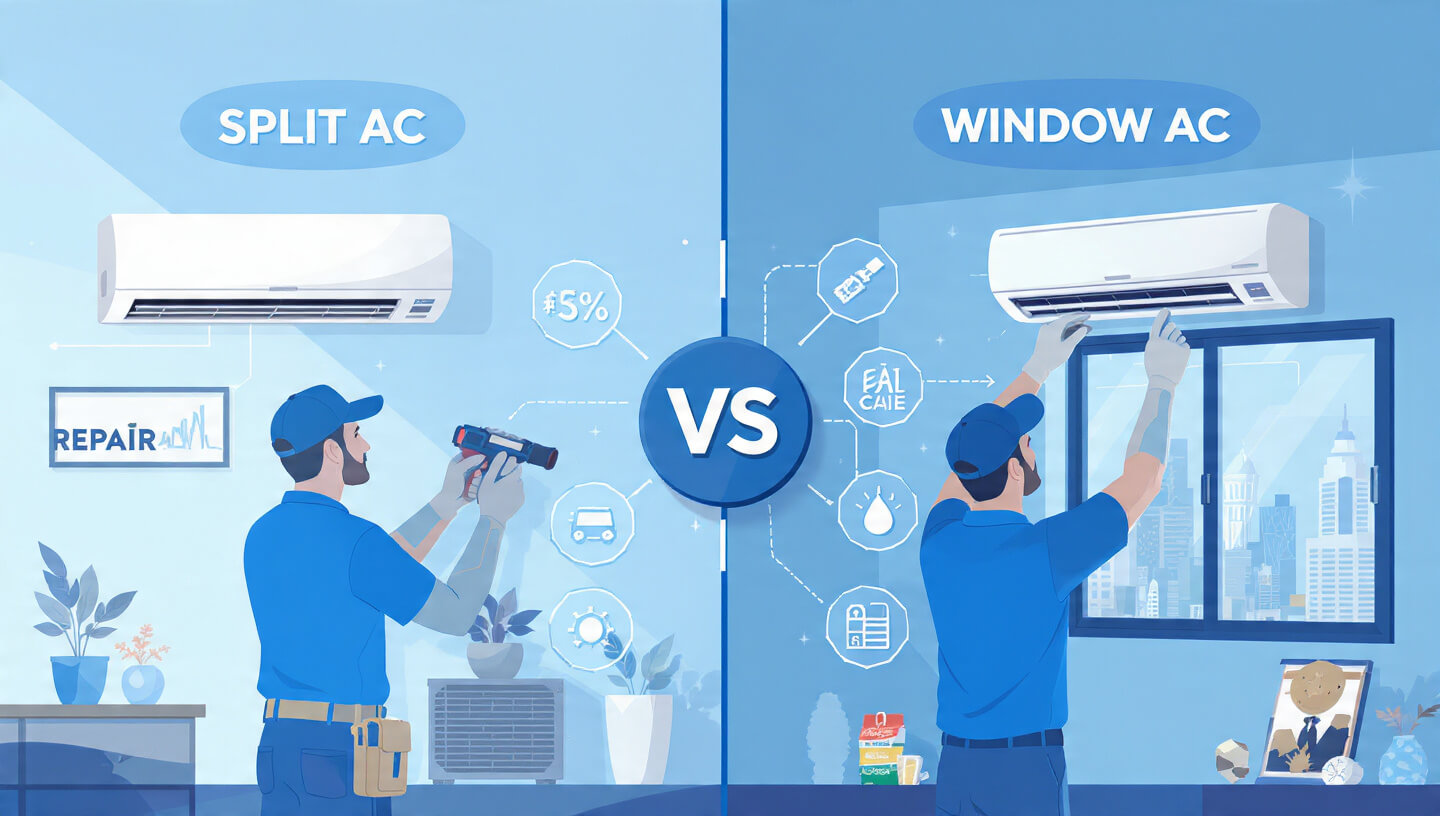
A split AC consists of two units: an indoor unit (evaporator and blower) and an outdoor unit (compressor and condenser). The units are linked by refrigerant piping, and the compressor sits outside, making split systems quieter indoors. Split ACs are available in single-zone or multi-zone configurations, meaning one outdoor unit can support multiple indoor units.
What Is a Window AC?
A window AC is a single packaged unit that fits into a window, wall opening, or specially built slot. All cooling components — compressor, condenser, and evaporator — are in one box. Window ACs are more compact and typically used for single rooms or smaller spaces.
Both systems are common in Bahrain, but their maintenance, repair patterns, and performance can differ substantially given the local climate.
1. Cooling Performance in Bahrain’s Climate
Split AC
Split ACs generally offer more consistent and even cooling compared to window ACs. Because the compressor is outdoors, split systems handle heat loads better — particularly in larger rooms or multi-room homes. The separation of indoor and outdoor units also means more effective moisture removal, which is crucial in Bahrain’s humid coastal areas during summer.
Split ACs often have better air distribution and more precise temperature control. This leads to better comfort in living rooms, open-plan spaces, or bedrooms with high cooling demand.
Window AC
Window ACs can cool smaller spaces effectively but struggle in larger rooms or spaces with high sun exposure. They tend to blow cold air in a more directional, less distributed manner. In Bahrain heat, a window AC may run almost continuously to maintain desired temperatures, which increases wear and tear.
2. Installation and Setup Differences
Split AC Installation
Installing a split AC involves mounting the indoor unit, placing the outdoor unit, and running refrigerant lines and electrical wiring between them. Proper installation requires professional technicians, precise piping insulation, and secure mounting to avoid vibration or leakage.
Because of this, split AC installation cost is higher than a window AC. However, professional installation ensures strong performance and reduces premature maintenance needs.
Window AC Installation
Window ACs are simpler to install: the unit fits into an existing opening or a prepared slot in a wall. Most of the time, installation can be done in a few hours by a technician without complex piping or external units.
While convenience is a plus, improper installation can allow hot air or dust infiltration around the unit if not sealed properly.
3. Repair Costs & Common Issues
Split AC Repair Costs
Split ACs have more components, and therefore repair needs tend to be more varied:
- Refrigerant leaks are common if piping or connectors weren’t sealed properly during installation.
- Compressor problems can arise due to frequent cycling or extreme heat.
- Sensor faults inside the indoor unit can affect thermostat readings.
- PCB / control issues can occur during power surges or humidity exposure.
- Fan or blower motor wear due to dust and high humidity.
Because split ACs have more parts that can fail, repair costs can be higher than window ACs — but many issues are avoidable with scheduled maintenance.
Window AC Repair Costs
Window ACs share all components in a single unit, which makes pinpointing some problems easier — but it also makes other issues harder to fix:
- Compressor failure often requires full unit replacement rather than part swap.
- Condenser coil damage due to dust and outdoor exposure.
- Fan or motor failure within the single unit can be inexpensive or costly depending on model.
- Thermostat or dial control issues might be cheaper to fix.
While simpler in design, some window AC repairs (like compressor replacement) often represent a large percentage of the unit cost. In Bahrain’s climate, where units are under heavy use for long periods, compressor and coil issues are among the most common failures.
4. Maintenance Comparison (Bahrain Context)
Split AC Maintenance
Split systems require regular servicing for:
- Filter cleaning every 2–4 weeks during peak usage
- Outdoor unit cleaning of condenser coils to prevent overheating
- Refrigerant level checks to avoid inefficient cooling
- Drain line clearing to prevent water backup or mold growth
- Periodic professional inspection (every 6 months)
Regular maintenance prolongs life and reduces emergency repairs.
Window AC Maintenance
Window AC servicing typically involves:
- Filter cleaning monthly, because dust buildup is faster
- General coil and fin cleaning to improve heat exchange
- Ensuring sealing around unit remains tight
- Checking cooling efficiency each season
Because all parts are in one unit, dust and sand accumulation affect performance quickly in Bahrain. While maintenance is simpler, frequency must be higher.
5. Energy Efficiency — Operating Costs in Bahrain
Split ACs tend to be more energy efficient than window ACs because:
- They use inverter technology more often
- They distribute air more evenly
- They maintain set temperature with less cycling
Window ACs can be less efficient because they often run at one or two fixed speeds and may cycle on/off more frequently.
Given Bahrain’s high electricity costs during summer, efficiency adds up: a more efficient split AC can represent lower monthly bills and less strain on electrical infrastructure.
6. Noise and Indoor Comfort
Split AC
Because the compressor sits outside, split ACs are generally quieter indoors. This improves comfort in bedrooms and study rooms and makes them ideal for long hours of operation.
Window AC
Since the compressor is inside the same box as the blower and evaporator, window ACs tend to be louder. In quieter spaces (bedrooms, offices), noise can be a noticeable downside.
7. Aesthetics and Home Integration
Split ACs are more discreet and blend into modern interiors. Their indoor units can be mounted high or hidden within cabinets.
Window ACs, by contrast, protrude from windows or walls and are more noticeable — which may be acceptable in utility rooms or kitchens but less desirable in living rooms and bedrooms.
8. Lifespan and Long-Term Value
Split ACs often have a longer lifespan because:
- Outdoor compressors are shielded
- They distribute workload efficiently
- They are easier to service modularly
Window ACs may have shorter lifespans in high-usage environments because:
- All components operate in one stressed unit
- Dust, heat, and vibration accumulate faster
- Major failures often require entire unit replacement
In Bahrain, where ACs run many months of the year, long-term durability matters.
When to Choose Split AC vs Window AC in Bahrain
Choose Split AC If:
- You want quieter operation
- You have larger rooms or multi-room cooling needs
- You plan to stay in your home long term
- You want better energy efficiency
- You want more precise temperature control
- You are okay with a higher upfront and maintenance cost
Choose Window AC If:
- You are cooling a small room or occasional use space
- You want lower upfront cost and simpler installation
- Quick maintenance and DIY filter cleaning are priorities
- You don’t mind slightly louder operation
- You want a temporary or budget cooling solution
FAQ — AC Repair & Maintenance in Bahrain
1. How much does split AC repair cost in Bahrain?
Split AC repair costs vary by part and issue. Minor fixes (filter cleaning, sensor replacement) may range lower, while compressor or PCB repairs can be higher. Always ask for a diagnostic estimate before authorizing work.
2. How often should I service my AC in Bahrain?
Split ACs benefit from professional servicing every 6 months, especially before summer. Window ACs should be checked at least once per cooling season.
3. Why does my AC freeze up during Bahrain summer?
Freezing often indicates restricted airflow (clogged filter), low refrigerant levels, or incorrect thermostat settings.
4. Do inverter split ACs save money?
Yes. Inverter ACs adjust compressor speed to meet cooling needs without constant starts and stops, improving energy efficiency.
5. Is installation cost much higher for split ACs?
Yes. Because split ACs require professional installation of indoor and outdoor units with refrigerant lines, installation costs are higher than for window ACs.
6. Can I service my AC myself?
Basic tasks like filter cleaning are safe DIY. Deeper tasks ( refrigerant recharge, electrical diagnosis) require professional technicians.
7. What’s the best AC temperature setting for Bahrain?
A range of 22°C–24°C balances comfort and electricity savings without overworking your system.
Conclusion
Choosing between a split AC and a window AC in Bahrain isn’t just about price or brand. It’s about cooling performance, maintenance demands, repair costs, noise levels, energy efficiency, and long-term durability in a hot, humid, and dusty climate.
Split ACs generally offer higher performance, quieter operation, better efficiency, and longer lifespan — but come with higher installation and maintenance requirements. Window ACs are more affordable and easier to install for single rooms, but may cost more in repairs and energy over time and are less reliable for larger areas.
When choosing, consider how long you’ll use the system, your budget, your space layout, and how much maintenance you’re willing to commit to. And always check for certified technicians with experience in Bahrain’s climate when it’s time for repair or servicing.
Call To Action
Need reliable AC repair in Bahrain? Contact trusted technicians who specialize in both split AC and window AC services — from diagnostic checks to full system repairs — with fast, professional service across Manama, Muharraq, Riffa, Saar, and more.